

SUSTAINABILITY
Challenges
Selecting the right paper for each application helps ensure optimal product performance while promoting the responsible use of resources.
CHOOSING THE RIGHT MATERIALS

Optimising raw material usage by offering basis weights tailored as closely as possible to our customers' actual requirements, helping to reduce waste.
CONSUMING MORE RESPONSIBLY

Supporting the circular economy through the use of recyclable fibres and the recovery and reuse of our production off-cuts.
INCREASING RECYCLING
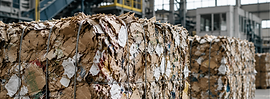
La Nationale des Papeteries' Commitments


RECYCLABLE MONO-MATRIAL
Natural and recycled kraft paper is fully recyclable, biodegradable and compostable, helping businesses meet today’s environmental challenges.
CERTIFIED VIRGIN & RECYCLED FIBRES
The paper we convert is made from recycled or virgin fibres sourced from PEFC® - or FSC™ -certified forests, where harvested trees are regenerated as part of sustainable forest management practices.
RESPONSIBLE PRODUCTION
By prioritising short supply chains and responsible practices, we reduce environmental impact while maintaining the highest quality standards.
FSC® and PEFC™ certifications
Our papers are certified FSC® and PEFC™, ensuring that the fibres used originate from sustainably managed forests and controlled sources. Through certified Chain of Custody systems, every stage, from forest to finished product, is subject to rigorous monitoring, guaranteeing the responsible origin of the materials used.
The shared principles of FSC® and PEFC™
Ensure responsible forest resource management, protect biodiversity and promote the natural regeneration of forests.
Respecting the rights of workers and local communities while promoting responsible working conditions.
Support sustainable forest management to ensure long-term forest viability and a responsible supply of raw materials.

Choosing certified paper means supporting the responsible management of forest resources.
Paper: a sustainable resource
Contrary to common misconceptions, the use of paper does not contribute to deforestation. In fact, quite the opposite is true.
As a renewable, locally sourced and recyclable material, paper plays a key role in the transition towards a more responsible economy. A single paper fibre can be recycled between five and seven times, making paper a highly efficient material within a circular economy model.
With nearly 15 million hectares, representing approximately one quarter of the country's land area, French forests are expanding by around 50,000 hectares every year, thanks in part to the efforts and investments of the paper industry. By valorising sawmill by-products and thinning wood, the sector actively contributes to the sustainable management and regeneration of forests.

CARBON FOOTPRINT OF RECYCLED PAPER

CARBON FOOTPRINT OF VIRGIN FIBRE PAPER

METHODOLOGY
A closer look at the indicator used
-
Carbon intensity = Total CO₂ emissions / Total distance travelled
-
Logistics efficiency = Total weight transported / Total distance travelled
-
Transport carbon intensity = Total CO₂ emissions / Total weight transported
* Virgin fibre and recycled papers are 100% recyclable, except in the following cases:
Organic contamination: Paper contaminated with grease or food residues cannot be recycled.
Multi-material structures: Laminated kraft paper (with an internal plastic or aluminium layer) requires dedicated recycling streams.
Chemical treatments: Varnishes or water-resistant treatments can hinder the recycling process.
Adhesives: Non-water-soluble glues and adhesive tapes can contaminate the paper pulp.
Fibre degradation: Paper fibres deteriorate with each recycling cycle and can typically be recycled only 5 to 7 times.
Foreign materials: Plastic windows, synthetic handles or other non-separated components may result in the rejection of the recycling batch.
PARCEL DELIVERY DATA
-
Heavy Goods Vehicle (Direct Full-Truckload Transport): Approx. 0.06 to 0.10 kg CO₂ per tonne-kilometre
-
Parcel Distribution Network (Groupage Transport): Approx. 0.20 to 0.50 kg CO₂ per tonne-kilometre
In summary, transporting 1 tonne of paper through a parcel distribution network typically generates 2 to 4 times more carbon emissions than shipping it via a dedicated full truckload.